Concrete Construction for Mixed-Use Development: 2026 Structural Trends
Could a single legislative shift in 2025 render your traditional site plan obsolete before you even break ground? With Texas Senate Bill 840 now in full effect across major metros, developers are rapidly pivoting to higher-density projects to address the state's 320,000-home shortage. This surge in activity places immense pressure on concrete construction for mixed-use development, where the cost of a structural failure in a dense urban setting is unforgiving. You understand that building in Texas requires a disciplined approach to foundation design, especially when dealing with the state's notorious expansive clay soils that threaten long-term stability.
We're here to provide the technical clarity you need to manage these complexities with confidence. You'll discover how modern concrete engineering is reshaping Texas mixed-use projects through structural efficiency and urban density solutions that prioritize reliability. This article examines the ROI of cast-in-place versus podium slabs, the seamless integration of parking foundations with vertical structures, and the 2026 ASTM standards that are defining the future of durable, high-performance materials.
Key Takeaways
- Evaluate the structural requirements that determine whether podium decks or cast-in-place midrise methods are the most viable choice for high-density Texas urban cores.
- Gain insight into the integration of CIP concrete parking structures and how shared infrastructure supports the increased load-bearing demands of modern ground-floor retail.
- Examine the critical role of paving stabilization in ensuring the long-term integrity of concrete construction for mixed-use development within challenging soil environments.
- Recognize the operational security provided by a single-source contractor capable of managing the transition from mass soil excavation to complex structural concrete execution.
The Evolution of Mixed-Use Developments in Texas
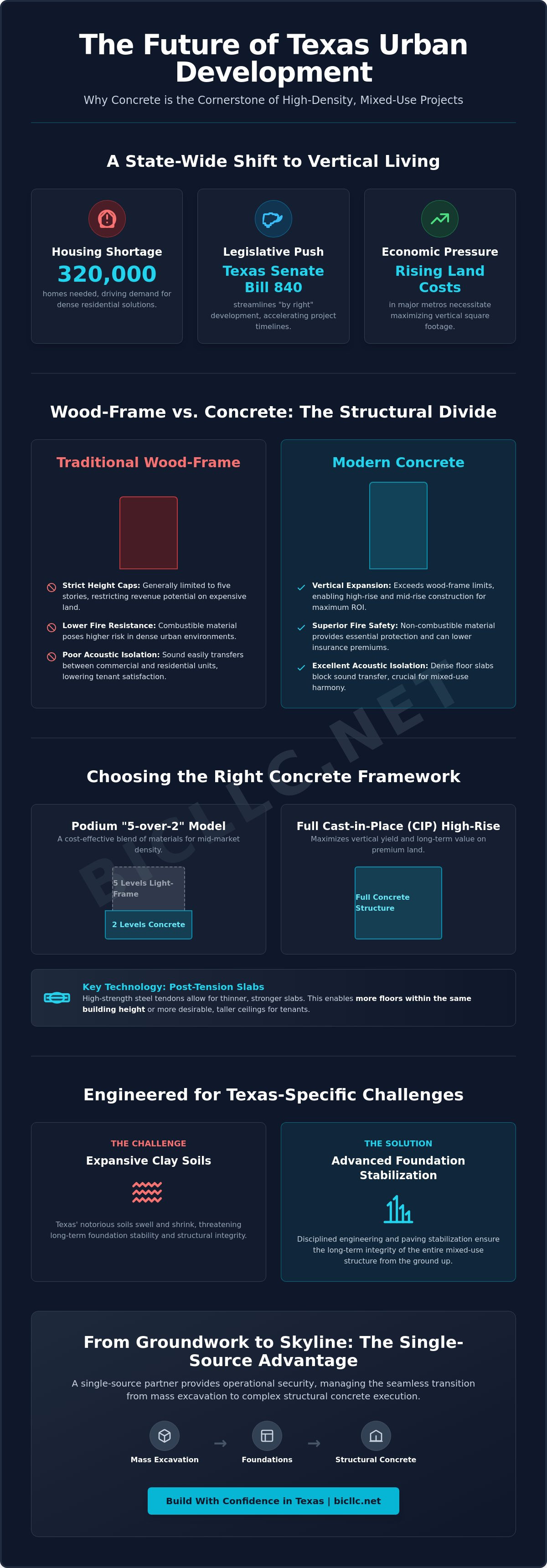
Texas urban centers are experiencing a fundamental shift in how people occupy space. In the urban cores of Austin, Houston, and Dallas, the traditional separation of residential and commercial zones is giving way to high-density mixed-use development. This transition isn't merely a trend; it's a structural response to rising land costs and a documented state-wide shortage of approximately 320,000 homes. To maximize the value of every square foot, developers are turning to advanced concrete construction for mixed-use development to provide the verticality and load-bearing capacity that modern urban hubs require. With the implementation of Texas Senate Bill 840, which streamlines "by right" development in commercial zones, the demand for these sophisticated structures has never been higher.
Defining the 2026 Mixed-Use Project
Modern projects in 2026 are complex ecosystems. They must support the high-traffic demands of ground-floor retail while maintaining the privacy and acoustic isolation required for residential tiers above. This duality creates unique engineering challenges. Ground-floor commercial spaces often require expansive, open-concept footprints to attract high-tier tenants. To achieve this without compromising stability, we utilize high-strength concrete columns and deep foundations that can withstand significant point loads. Additionally, there's a growing emphasis on operational sustainability. Utilizing concrete mixes that incorporate supplementary cementitious materials helps projects meet LEED certifications while maintaining the structural integrity necessary for long-term viability.
Why Wood-Frame Alone No Longer Suffices
While wood-frame construction has its place in suburban settings, it faces severe limitations in the context of 2026 urban density. Stick-built structures have strict height caps that limit potential revenue on expensive Texas land. Concrete provides the solution through the implementation of transfer levels. These robust slabs allow for a transition between different structural grids, such as moving from the wide spans of a retail level to the more segmented layout of residential units. Beyond height and layout flexibility, the choice of concrete is a commitment to security. It offers superior fire resistance and acoustic dampening, which translates directly into lower insurance premiums and higher tenant satisfaction. In a market where long-term durability is a core value, concrete construction for mixed-use development stands as the standard for buildings designed to last.
- Height Efficiency: Concrete allows for vertical expansion beyond the five-story limit of traditional wood framing.
- Acoustic Isolation: Dense floor slabs naturally block sound transfer between commercial and residential tenants.
- Fire Safety: Non-combustible materials provide essential protection in high-density urban environments.
- Operational Precision: Concrete allows for precise utility integration within the structural frame.
Structural Concrete Methods: Podium Slabs vs. CIP High-Rise
Selecting the right structural framework is a pivotal decision in concrete construction for mixed-use development. Developers often weigh the "5-over-2" podium model against full Cast-in-Place (CIP) high-rise structures. The 5-over-2 model, which typically features two levels of concrete podium supporting five levels of light-frame construction, has become a staple in Texas urban development. It offers a balance of cost and density that suits many mid-market projects. However, as land prices in Dallas and Houston continue to rise, the transition to full CIP midrise and highrise structures becomes a necessity for those seeking to maximize vertical yield and long-term asset value. This shift requires a disciplined approach to engineering that prioritizes structural continuity over short-term speed.
Efficiency in these projects often hinges on the use of Post Tension Slabs. By utilizing high-strength steel tendons within the concrete, engineers can design thinner slabs that maintain high load-bearing capacities. This optimization directly impacts the floor-to-ceiling height. Thinner slabs allow for additional floors within the same building envelope or taller, more desirable interior spaces for luxury residential units. This technical precision is a hallmark of disciplined engineering, ensuring every inch of the structure contributes to the project's overall ROI. It's a methodical way to build that respects both the developer's budget and the tenant's experience.
The Mechanics of Podium Slab Construction
A concrete podium serves as a vital fire-rated platform. It separates the high-traffic retail or restaurant spaces on the ground floor from the residential units above. Engineering these slabs requires a focus on heavy retail loads and complex utility routing. Reliability in this phase is non-negotiable. Meticulous attention to waterproofing and joint sealing is essential to prevent future maintenance crises. A failure in the podium deck's integrity can lead to costly repairs and tenant disputes, making the quality of the initial pour a cornerstone of the building's viability.
Cast-in-Place (CIP) for Maximum Density
When a project exceeds the height limitations of a podium, CIP midrise and highrise methods take precedence. Continuous CIP pours provide a monolithic structure with superior structural continuity. In high-wind zones along the Texas coast or in dense urban corridors, this continuity offers better resistance to lateral forces than pre-manufactured components. CIP also grants architects the freedom to design unique footprints and curved facades that distinguish a property in a competitive market. For developers ready to scale, establishing a partnership for structural concrete excellence ensures the project meets these rigorous technical demands.
While precast options are often marketed for speed, they can lack the seamless integrity of a field-poured structure. CIP construction allows for on-site adjustments and ensures a precise fit for complex MEP (mechanical, electrical, and plumbing) integrations. This methodical approach to construction reduces the risk of long-term structural settling or alignment issues. Choosing between a podium or a full CIP structure requires a thorough analysis of the site's specific needs, including soil conditions and intended density, to ensure the resulting foundation is built for the decades ahead.
Engineering for Urban Density: CIP Garages and Shared Infrastructure
Urban density in Texas cities demands a departure from sprawling surface lots. When developers approach concrete construction for mixed-use development, the parking structure is often the most complex piece of the structural puzzle. Integrating these garages directly into the building's footprint requires a seamless transition from the primary foundation to the multi-level decks above. While some market alternatives focus solely on precast components, a truly integrated approach considers how the garage serves as a structural anchor for the entire project. It's not just about storage for vehicles; it's about establishing a stable base for the retail and residential tiers that follow.
For many high-density sites, the advantages of CIP garage construction are clear, particularly for subterranean levels. Cast-in-place methods provide a monolithic quality that is naturally superior in managing water ingress and structural vibration. Subterranean decks face constant hydrostatic pressure from the surrounding soil. A continuous pour ensures there aren't cold joints or seams that could compromise the structure's long-term security. Even for above-ground decks, the rigidity of a CIP structure provides a sense of stability and permanence that tenants value. This methodical approach to construction ensures that the parking component doesn't become a maintenance liability in the years to come.
Parking Garage Foundations and Structural Slabs
The choice between slab-on-grade and structural slabs depends entirely on the site's soil profile and the intended traffic volume. In areas with unstable clay, a structural slab is often the more reliable choice to prevent cracking and shifting. Designing for multi-level structures also requires precise management of drainage and slope. Water must move efficiently toward internal drains to prevent pooling, which can lead to rebar corrosion over time. Additionally, retaining walls are essential for urban sites where elevation changes must be managed within tight property lines. These walls aren't just decorative; they're critical structural components that protect the garage's perimeter and the building's overall footprint.
Underground Utilities and Site Readiness
Successful execution begins long before the first concrete truck arrives. Coordinating storm sewers and water lines is a methodical process that must be completed during the initial mass soil excavation phase. In dense urban environments, space for detention ponds is often non-existent, requiring these systems to be integrated beneath the concrete slab or parking deck. This "hidden" infrastructure is just as vital as the visible columns. When earthwork and civil utilities are managed as part of an integrated site package, it eliminates the coordination gaps that often lead to foundation settling or utility failures. It's a disciplined way to ensure the project's long-term viability and operational precision.
- Mass Soil Excavation: Establishing the correct subgrade is the first step in protecting the structural slab.
- Integrated Detention: Utilizing subterranean space for water management maximizes the buildable area above.
- Utility Coordination: Precise placement of water and sewer lines prevents future slab penetrations.
- Retaining Wall Integrity: Ensuring perimeter stability is non-negotiable for multi-level urban footprints.
Overcoming Texas Soil Challenges in Mixed-Use Foundations
Texas soil conditions, particularly the expansive clay found in North and Central Texas, present a significant risk to structural longevity. These soils undergo substantial volume changes based on moisture content, which can exert immense pressure on foundations. In the context of concrete construction for mixed-use development, where building loads are heavy and varied, soil stabilization is a non-negotiable phase of the project. We prioritize a methodical approach to mass soil excavation and replacement to ensure the structure rests on a stable, predictable base. This process protects high-rise foundations from the shifting forces that often lead to structural distress in less disciplined builds.
Paving Stabilization Techniques
Reliable infrastructure extends beyond the building's footprint to the surrounding site work. Paving stabilization techniques are essential for maintaining the long-term viability of high-traffic parking lots and fire lanes. We utilize both chemical and mechanical stabilization methods to enhance the load-bearing capacity of the subgrade. For projects requiring commercial concrete paving in Conroe, ensuring the subbase meets rigorous ASTM standards for compaction is the only way to prevent premature cracking. This attention to detail ensures that the civil components of the project match the durability of the vertical structure.
Foundation Slabs and Post-Tensioning
Post-tensioning serves as a critical defense against the inherent volatility of Texas clay. By introducing internal compressive stresses, post-tension slabs are better equipped to resist the bending forces caused by soil movement. Monitoring moisture content in high-plasticity index (PI) soils is a disciplined requirement throughout the construction process to prevent slab heave. A structural slab-on-grade is a reinforced concrete foundation designed to transfer building loads directly to the ground while providing a durable, level surface for commercial operations. To secure your project's future, establishing a partnership for paving stabilization and foundation excellence is a vital step in your development strategy.
Managing runoff is a technical necessity for large-scale developments. Detention ponds are engineered to regulate the flow of stormwater, protecting both the site and the surrounding municipal infrastructure. These systems must be carefully integrated into the overall civil plan to ensure they don't interfere with the primary building foundations. By managing water effectively, we preserve the integrity of the soil stabilization work and ensure the site remains secure during extreme weather events. This integrated approach to earthwork and structural concrete is what defines a project built for long-term viability.
- Soil Stabilization: Chemical treatment of clay reduces the potential for vertical rise.
- Mass Soil Excavation: Removing unsuitable material is the first step in protecting the structural frame.
- Post-Tension Slabs: Internal reinforcement provides the flexibility needed for expansive soils.
- ASTM Compliance: Strict adherence to compaction standards ensures a predictable foundation.
Partnering for Integrated Concrete Solutions
The successful execution of concrete construction for mixed-use development depends on the seamless coordination of multiple technical disciplines. When a developer manages separate contractors for mass soil excavation, underground utilities, and structural concrete, the risk of scheduling overlaps and communication gaps increases. A single-source partnership eliminates these friction points by establishing a clear hierarchy of responsibility from the initial site prep to the final structural pour. This integrated approach ensures that the foundation work is perfectly aligned with the vertical requirements of the podium or CIP high-rise tiers, maintaining a steady and predictable construction rhythm.
Efficiency in 2026 urban projects is often a product of disciplined logistics. Managing a high-density site requires a partner who understands the relationship between the subterranean infrastructure and the residential units above. By centralizing the management of civil and structural phases, we ensure that every technical requirement is met without the need for redundant oversight. This methodical oversight is what allows a project to transition smoothly from the challenges of Texas clay to the precision of a finished post-tension slab. It's a commitment to substance that prioritizes the long-term viability of the asset.
Efficiency Through Turnkey Civil and Concrete
Reducing mobilization costs is a primary benefit of utilizing a turnkey civil strategy. By combining site preparation with concrete paving and structural work, we consolidate equipment moves and labor management. This synergy is particularly valuable when installing underground utilities. When the same team handles the excavation and the slab placement, there's a higher degree of precision in utility stub-ups and drainage alignment. This integrated service prevents the costly delays that occur when a concrete finisher must wait for an earthwork team to reach the correct subgrade elevation. It's an organized way to build that respects both the timeline and the budget.
Commitment to Quality and Professional Stability
Born Integrated Construction prioritizes safety and operational precision, especially in high-traffic urban zones where space is limited and public security is paramount. Our team manages the logistical complexities of CIP midrise and highrise foundations with a focus on long-term stability. We believe that professional reliability is built on proven results and the meticulous management of every detail, from rebar placement to the final finish. Maintaining these high standards across all phases of construction provides the security developers need in the competitive Texas market. Partner with Born Integrated Construction for your next mixed-use project to ensure your structural foundations are as enduring as your professional reputation.
- Single-Source Accountability: One point of contact for earthwork, civil utilities, and structural concrete.
- Schedule Streamlining: Eliminating downtime between excavation and the first structural pour.
- Urban Safety Expertise: Disciplined management of high-density construction environments.
- Resource Reliability: Strong vendor relationships ensure consistent material delivery and quality.
Building for Long-Term Structural Viability
The landscape of Texas urban cores is changing rapidly, driven by legislative updates and a significant housing shortage. Success in this environment requires a disciplined approach to concrete construction for mixed-use development that accounts for everything from expansive clay soils to the integration of complex parking infrastructure. You've seen how selecting the right structural method, whether it's a podium slab or a full CIP high-rise, impacts the long-term integrity and yield of your project. Meticulous planning in the early civil and earthwork phases is the only way to ensure these structures remain stable for decades.
Born Integrated Construction provides the stability and technical proficiency needed for these high-density sites. As specialists in CIP midrise and highrise foundations, we offer full-service turnkey civil and structural concrete solutions across the Houston, Austin, and Dallas metro areas. Our commitment to operational precision ensures that your project is built on a foundation of substance and safety. We invite you to Request a Quote for Your Mixed-Use Concrete Project to establish a partnership built for the decades ahead. We look forward to delivering the steadfast reliability your development deserves.
Frequently Asked Questions
What is the best concrete method for a mixed-use development with retail and residential?
The ideal method depends on the project's total height and density requirements. For mid-rise projects, podium slabs are the standard for concrete construction for mixed-use development because they provide a fire-rated structural platform for lighter framing above. If the project exceeds seven stories, a full cast-in-place (CIP) high-rise method is typically required to maintain structural continuity and the necessary vertical load capacity for the entire frame.
How does a podium slab differ from a traditional high-rise foundation?
A podium slab serves as a structural transfer level that allows for different building materials, such as wood or light-gauge steel, to be utilized above a concrete base. Traditional high-rise foundations for CIP midrise and highrise structures are part of a continuous, monolithic concrete frame that extends through every floor. This monolithic approach provides superior resistance to lateral forces and wind loads in dense urban environments.
Why is soil stabilization so important for Texas concrete construction?
Soil stabilization is essential in Texas to counteract the high-plasticity clay soils that expand and contract significantly with moisture changes. Without proper chemical or mechanical stabilization, the foundation is at risk of heave and structural cracking. This process establishes a predictable, stable subgrade that protects the building's long-term integrity and reduces future maintenance costs for both the structure and the surrounding paving.
Can CIP parking garages be built faster than precast options?
While precast components can be erected quickly, CIP parking garages offer superior structural integration with the primary building footprint. Cast-in-place methods eliminate the joints and seams found in precast systems, which improves waterproofing and reduces structural vibration. For subterranean decks, the monolithic nature of CIP is often the more reliable choice for managing hydrostatic pressure and ensuring a seamless foundation.
What are the benefits of post-tension slabs in mixed-use buildings?
Post-tension slabs allow for thinner floor profiles and significantly longer spans between supporting columns. This structural optimization increases the available floor-to-ceiling height for residential units and provides more flexibility for open-concept retail layouts on ground floors. Additionally, the internal compression provided by the tendons helps the slab resist the shifting forces characteristic of the expansive soils found throughout Texas.
How do you manage underground utilities in a dense mixed-use site?
Managing underground utilities requires precise coordination during the initial mass soil excavation phase. Integrated site work ensures that storm sewers, water lines, and electrical conduits are placed accurately before the first structural pour. This disciplined approach prevents the need for costly slab penetrations later and ensures that all shared infrastructure fits seamlessly within the building's footprint without compromising structural integrity.
What is the role of a detention pond in commercial concrete development?
Detention ponds are engineered to manage stormwater runoff and prevent the flooding of surrounding municipal infrastructure. In concrete construction for mixed-use development, these systems are integrated into the civil plan to regulate the release of water during heavy rain events. This protects the site's soil stabilization work and ensures the property remains compliant with local drainage regulations and environmental standards.
How does Born Integrated Construction manage project safety on urban sites?
Born Integrated Construction manages safety through a methodical and disciplined approach to urban site logistics. We prioritize clear communication and rigorous adherence to safety protocols in high-traffic construction zones where space is limited. Our team's deep experience in turnkey civil and structural concrete allows us to maintain a secure environment while managing the complex transition from soil excavation to vertical construction.