Expert Podium Slab Contractor in Houston: Structural CIP Solutions for 2026 Developments

In Houston, a foundation isn't just a structural base; it's a calculated defense against expansive Beaumont clay and the city's rigorous 2026 building codes. Developers often face significant bottlenecks when structural concrete pours fall behind schedule or when site prep doesn't align with the podium's requirements. Securing a specialized podium slab contractor Houston firms can trust is the most effective way to maintain momentum while ensuring long-term stability. You need a partner who understands that structural integrity begins with the soil and ends with a precise, professional finish.
This article details how an expert cast-in-place contractor manages the complex transition from mass excavation to structural execution. You'll learn how to meet the 140 mph wind load enhancements of ASCE 7-22 and the updated Chapter 19 flood regulations that require elevations two feet above the 500-year flood level. We'll explore the technical precision required for 2026 developments, focusing on turn-key solutions that bridge the gap between site stabilization and the final podium deck. Our guide provides a methodical look at achieving compliance and efficiency in Houston's evolving construction market.
Key Takeaways
- Understand the critical role of the transfer slab as the structural interface in mixed-use projects and why it remains the preferred choice for 2026 Houston developments.
- Learn how cast-in-place (CIP) concrete and post-tensioning techniques optimize slab thickness and weight to enhance structural efficiency in multi-level podiums.
- Discover how a specialized podium slab contractor Houston developers trust addresses expansive clay soils through meticulous mass soil excavation and paving stabilization.
- Explore the operational advantages of integrating civil and structural services to reduce project friction and ensure a seamless transition from earthwork to vertical execution.
- Identify the value of partnering with a disciplined firm like Born Integrated Construction to ensure safety, code compliance, and professional stability for your next mid-rise project.
The Essential Role of a Podium Slab Contractor in Houston Developments
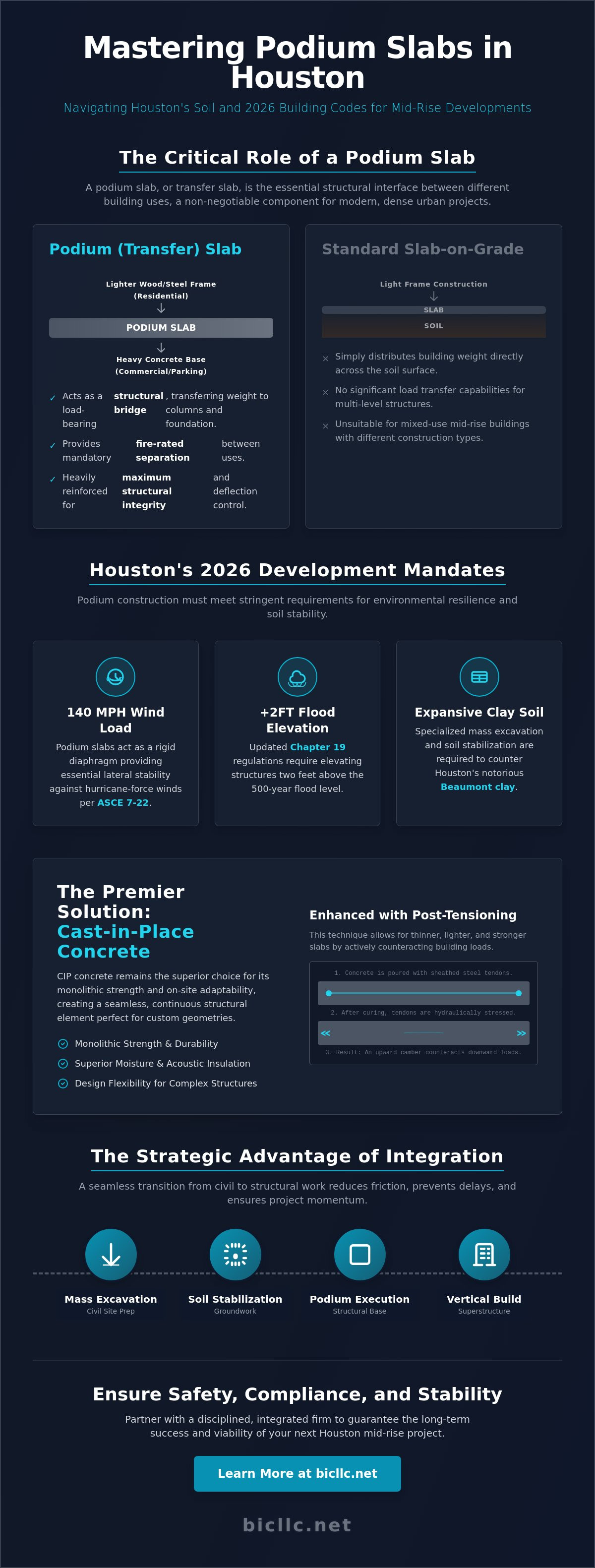
A podium slab, often referred to as a transfer slab, acts as the vital structural interface between two distinct building uses. In the context of Houston’s 2026 developments, this usually involves a heavy, cast-in-place concrete base that supports lighter wood-frame or light-gauge steel residential units above. This structural Concrete slab must manage immense vertical loads while providing a fire-rated separation between ground-floor commercial spaces and the residential dwellings. Choosing a qualified podium slab contractor Houston developers can rely on is essential for ensuring these complex load paths are properly executed and maintained.
The technical requirements for a structural podium deck are far more stringent than those for a standard slab on grade. While a slab on grade distributes weight across the soil surface, a podium deck functions as a load-bearing bridge. Key differences include:
- Load Transfer: Podium decks must safely redirect the weight of several residential stories to the columns and foundation.
- Fire Resistance: The concrete provides a necessary thermal barrier between commercial and residential uses.
- Structural Integrity: These slabs are often thicker and more heavily reinforced to prevent deflection and cracking over time.
Because these structures are foundational to the building's life safety, a specialized cast-in-place concrete contractor must manage the project. They ensure that every pour meets the rigorous 2026 Houston building codes, focusing on the long-term viability of the asset rather than just the speed of construction.
Maximizing Urban Density with Podium Construction
Urban density in Houston is increasing as developers look for ways to maximize limited land area in 2026 mixed-use projects. Podium construction allows for ground-floor retail, lobbies, or parking structures while providing a stable platform for residential levels. This vertical stacking is a hallmark of modern Houston architecture. It provides the flexibility to create vibrant, walkable communities within a single footprint. By utilizing structural concrete transfer decks, builders can achieve the height and density required by city planning while maintaining the economic benefits of varied construction materials.
Structural Stability and Wind Load Requirements
Texas Gulf Coast developments must adhere to rigorous wind load standards, particularly with the 140 mph gust requirements integrated into current building codes. A structural podium deck serves as a rigid diaphragm, providing lateral stability to the entire building. High-strength concrete mixes are utilized to ensure the structure can withstand these environmental pressures over decades. Precise reinforcement placement is non-negotiable; every bar and tendon must align with engineered specifications to guarantee the longevity and safety of the mid-rise project. Reliability in this phase is the cornerstone of a successful development.
Technical Excellence in Cast-in-Place (CIP) Podium Construction
Cast-in-place (CIP) concrete remains the premier choice for multi-level podium structures due to its inherent adaptability and monolithic strength. Unlike precast alternatives that may struggle with transportation limits or joint vulnerabilities, CIP allows for a continuous structural element that integrates seamlessly with the building's vertical supports. For a podium slab contractor Houston developers select for high-stakes projects, the ability to manage on-site variables is a primary differentiator. CIP construction accommodates the custom geometries often required in Houston’s mid-rise sector, ensuring that structural loads are distributed with absolute precision. This method also facilitates better moisture resistance and acoustic insulation between different building uses, which is essential for the longevity of mixed-use assets.
Post-Tension Slabs and Structural Framing
Post-tensioning is a sophisticated engineering method used to enhance the performance of structural concrete. By incorporating high-strength steel tendons that are stressed after the concrete has gained initial strength, we achieve thinner slabs without sacrificing load-bearing capacity. This technique allows for longer spans between columns, which is particularly advantageous for ground-floor parking garages where clear drive aisles and maximized parking counts are essential. The process requires meticulous coordination; tendons must be placed with exact tolerances, and stressing must follow a strict engineering sequence to prevent slab cracking. During the structural pour, our teams maintain close communication with MEP trades to ensure that sleeves and conduits don't interfere with the post-tensioning system. For those seeking structural concrete expertise, this level of technical coordination is a non-negotiable standard for maintaining the structural integrity of the transfer deck.
Formwork and Shoring Strategies
Managing the weight of wet concrete during a multi-level pour requires advanced formwork and shoring engineering. These temporary structures must be capable of supporting thousands of pounds per square foot while maintaining perfect level and alignment. Our approach prioritizes safety and operational efficiency through the use of high-capacity shoring systems designed for the specific demands of podium decks. Workers must adhere to strict OSHA requirements for cast-in-place concrete to prevent structural failure or falls during high-elevation installation. By implementing a methodical cycling strategy, we strip and move forms to the next level as soon as the concrete reaches the required compressive strength. This disciplined cadence keeps the project on schedule without compromising the safety of the job site. A seasoned podium slab contractor Houston trusts understands that the quality of the formwork directly dictates the quality and durability of the final finish.
Overcoming Houston Soil Challenges for Podium Foundations
Houston’s geological profile presents unique obstacles for structural concrete projects, primarily due to the presence of expansive Beaumont clay. This specific soil type undergoes significant volume changes based on moisture levels, which can exert immense pressure on a foundation. For a heavy, multi-story podium structure, these soil movements can lead to differential settlement and structural cracking if not mitigated during the early phases of construction. A podium slab contractor Houston firms trust must prioritize a comprehensive soil management strategy that begins long before the structural deck is formed. Adhering to the ACI Specifications for Structural Concrete ensures that the foundation is designed to withstand these local environmental pressures while maintaining the load-bearing requirements of 2026 building codes.
Moisture control is a critical factor in preventing the ground beneath a large-scale slab from shifting. Without a steadfast approach to site drainage and subgrade preparation, the structural integrity of the entire mid-rise development is at risk. We focus on establishing a stable environment where the concrete can perform as engineered, regardless of Texas weather cycles. This commitment to technical proficiency protects the long-term viability of the asset and provides a sense of security for developers and future occupants alike.
Soil Stabilization and Mass Excavation
Chemical and mechanical soil stabilization are non-negotiable steps in preparing a site for a structural podium. By treating the subgrade with lime or cement, we transform the expansive clay into a rigid, stable platform that resists volume changes. Mass soil excavation is equally critical; it involves removing unsuitable materials and replacing them with engineered fill to ensure a level and compacted base. This process is essential for creating a uniform bearing surface that supports the weight of the transfer slab and the residential units above. Proper paving stabilization provides the necessary longevity for ground-level parking and retail access points, preventing the common issue of undulating surfaces that plague poorly prepared sites.
Underground Utilities and Site Readiness
Site readiness extends beyond the soil surface to include the complex network of underground utilities that support a mid-rise development. Coordinating the installation of storm sewers and sanitary lines is vital to ensure that these systems are fully operational before the structural concrete work begins. We manage the construction of detention ponds to handle site runoff, which is a critical requirement under Houston’s 2026 flood mitigation regulations. Protecting domestic water systems during the heavy concrete phase requires a disciplined approach to site management, ensuring that heavy machinery and structural pours don't compromise the integrity of buried infrastructure. This integrated approach ensures that the earthwork and vertical phases work in harmony, reducing the risk of project-wide bottlenecks.
The Strategic Advantage of Integrated Civil and Structural Services
Project delays often stem from a lack of coordination between the site preparation team and the structural concrete crew. When these phases are managed by separate entities, the transition from earthwork to vertical construction becomes a high-risk factor for bottlenecks. A podium slab contractor Houston developers partner with for integrated civil and structural services eliminates these operational gaps. By consolidating mass soil excavation, detention pond construction, and structural podium work, we provide a unified workflow that prioritizes professional stability. This approach is essential for meeting the aggressive timelines of 2026 developments while maintaining a serious commitment to structural integrity.
Consolidating these services reduces project friction and minimizes mobilization costs. Managing multiple vendors often leads to scheduling conflicts that ripple through the entire build. A single-source provider streamlines the procurement of materials and ensures that equipment is utilized efficiently across different phases. This methodical approach creates a sense of security for stakeholders, knowing that the "dirt" and "vertical" phases are moving in lockstep toward a common goal.
Transitioning from Civil Site Work to Vertical Concrete
Transitioning from civil site work to vertical concrete requires absolute accountability. In many projects, the concrete team might blame the excavation crew for subgrade inaccuracies, leading to costly rework and finger-pointing. Our integrated model ensures that the subgrade is engineered with the specific requirements of the CIP garage and podium foundation in mind. This technical alignment is vital for long-term durability. Our experience with Commercial Concrete Paving in Conroe demonstrates how heavy-duty infrastructure depends on subgrade precision. By managing both the earthwork and the structural pour, we maintain total control over the project's foundation.
Cost-Effective Infrastructure Solutions
Cost-effective infrastructure solutions are a direct result of operational precision. We leverage shared personnel and machinery across multiple project phases, which significantly lowers overhead and mobilization expenses. Procurement is equally streamlined; we coordinate the delivery of high-strength concrete and reinforcement materials for both paving and structural slabs. This steadfast commitment to efficiency translates to a better ROI for developers who can't afford the hidden costs of vendor fragmentation. For those seeking a dependable partner to manage these complex variables, our turn-key civil and structural solutions provide the consistency needed for a successful, long-term asset.
Partnering with Born Integrated Construction for Your Houston Project
Success in the Houston mid-rise market depends on the reliability of your structural partners. Born Integrated Construction operates with a grounded and steadfast approach, prioritizing the long-term viability of every project. As a seasoned podium slab contractor Houston developers trust, we bring a deep-rooted commitment to high standards and operational precision. Our work in CIP midrise and highrise structural concrete is defined by a focus on building lasting foundations. We understand that our professional output represents the core of your investment, and we treat every structural pour with the seriousness it deserves.
We maintain established relationships with local vendors and engineering partners to ensure that material procurement and technical reviews move forward without delay. This network is a cornerstone of our professional stability. It allows us to navigate the complexities of the 2026 Houston building codes with confidence. We don't just pour concrete; we establish the structural framework that ensures the enduring nature of your development. Our methodical approach minimizes risk and provides a steady, predictable reading of the project's progress for all stakeholders involved.
Safety and Integrity in Large-Scale Concrete
Safety is a fundamental pillar of our organizational structure. We implement disciplined safety protocols specifically tailored for structural CIP and garage construction. These environments present unique risks, and our teams are trained to maintain a professional distance from hazards through meticulous planning and execution. We prioritize transparent communication with general contractors and developers, ensuring that every safety milestone is documented and met. Our focus on craftsmanship isn't just about aesthetics; it's about creating a product that stands the test of time. We take pride in delivering consistent value through ethical conduct and technical proficiency on every job site.
Next Steps for Your 2026 Development
Beginning the transition from design to physical execution requires a partner who can manage the breadth of technical scope. We encourage developers to request a comprehensive bid that integrates our civil and structural concrete services. This ensures that your project benefits from a unified strategy from the first day of mass soil excavation. Our team is available to consult on the specific requirements of CIP garage construction and how it interfaces with your podium deck. By engaging with a specialized podium slab contractor Houston firms can depend on, you secure a partner dedicated to substance and proven results. Contact Born Integrated Construction for a professional consultation on your Houston podium slab project.
Building for 2026 and Beyond: Establishing a Foundation of Structural Excellence
The success of a mid-rise project in the Texas Gulf Coast depends on the precision of its transfer deck and the stability of the soil beneath it. By integrating civil site work with advanced structural concrete execution, developers can navigate the complexities of 2026 building codes without the friction of vendor fragmentation. We've explored how post-tensioning optimizes slab performance and how chemical soil stabilization mitigates the risks posed by Houston's expansive clay. Choosing a podium slab contractor Houston developers can rely on ensures that these technical requirements are met with steadfast commitment and operational precision.
Born Integrated Construction specializes in CIP midrise and highrise structural concrete, providing the expertise needed for high-stakes urban density projects. Our team offers integrated civil site work and underground utility expertise to create a seamless transition from the ground up. We maintain a steadfast commitment to safety and operational precision in every pour. We invite you to Request a Quote for Structural Podium Concrete Services to see how our methodical approach can support your next project. We look forward to establishing a lasting foundation for your development.
Frequently Asked Questions
What is the difference between a podium slab and a slab on grade?
A podium slab serves as a structural transfer deck that supports elevated levels, while a slab on grade rests directly on the soil subgrade. Podium slabs are engineered to bridge spans and transfer heavy loads from residential or commercial floors above to the columns and foundation below. Unlike standard flatwork, these structural decks require precise reinforcement and high-strength concrete mixes to ensure long-term stability and life safety.
How long does it take to pour and cure a structural podium deck in Houston?
The timeline for pouring and curing depends on the project's scale and the specific concrete mix design. Generally, a structural deck reaches sufficient strength for post-tensioning within 3 to 7 days. While full compressive strength is typically measured at 28 days, our methodical approach ensures that the project maintains a steady cadence without compromising the integrity of the cure. Weather conditions in Houston are always factored into the schedule.
Why is post-tensioning used in podium slab construction?
Post-tensioning is utilized to increase the load-bearing capacity of the concrete while reducing the slab's overall thickness. By stressing high-strength steel tendons after the pour, we can achieve longer spans with fewer supporting columns. This is a critical advantage for structured parking garages where maximizing drive aisles and parking counts is a priority. It also reduces the total building weight, which is beneficial for Houston's soil conditions.
Does Born Integrated Construction handle both the excavation and the concrete pour?
Yes, we provide comprehensive turn-key civil and structural services. We manage the entire scope from mass soil excavation and underground utilities to the execution of the structural concrete. This integrated model eliminates the friction between different vendors and ensures that the subgrade preparation perfectly aligns with the requirements of the podium. It provides a more reliable and efficient path to project completion.
What are the specific soil stabilization requirements for Houston podium buildings?
Houston's expansive Beaumont clay necessitates rigorous soil stabilization to prevent differential settlement. This typically involves chemical treatment with lime or cement to modify the soil's plastic properties and create a stable, non-expansive base. As a specialized podium slab contractor Houston firms trust, we ensure that the mass excavation and paving stabilization phases are completed to exact engineering specifications before the structural work begins.
Can a podium slab support multi-story wood-frame residential units?
A structural podium slab is specifically designed to support multi-story wood-frame or light-gauge steel residential units. This construction style is a standard for Houston's mixed-use developments in 2026. The concrete deck acts as a fire-rated horizontal separation and a rigid platform that safely transfers the weight of the residential levels to the building's primary structural frame and foundation.
How does cast-in-place concrete compare to precast for podium decks?
Cast-in-place (CIP) concrete provides a monolithic, seamless structure that generally offers superior moisture resistance and architectural flexibility compared to precast. While precast components are manufactured off-site, CIP allows for real-time adjustments to custom geometries. This on-site execution ensures a tighter integration with the building's vertical elements, which is why a podium slab contractor Houston developers select often prefers the CIP method for custom mid-rise projects.
What safety certifications should a podium slab contractor in Houston hold?
A professional contractor must adhere to all OSHA standards for cast-in-place concrete and high-elevation work. This includes rigorous fall protection protocols and specialized training for post-tensioning and shoring operations. Reliability in this field is demonstrated through a disciplined safety record and a steadfast commitment to operational precision. You should verify that your partner maintains documented safety programs and has established relationships with local engineering firms.