
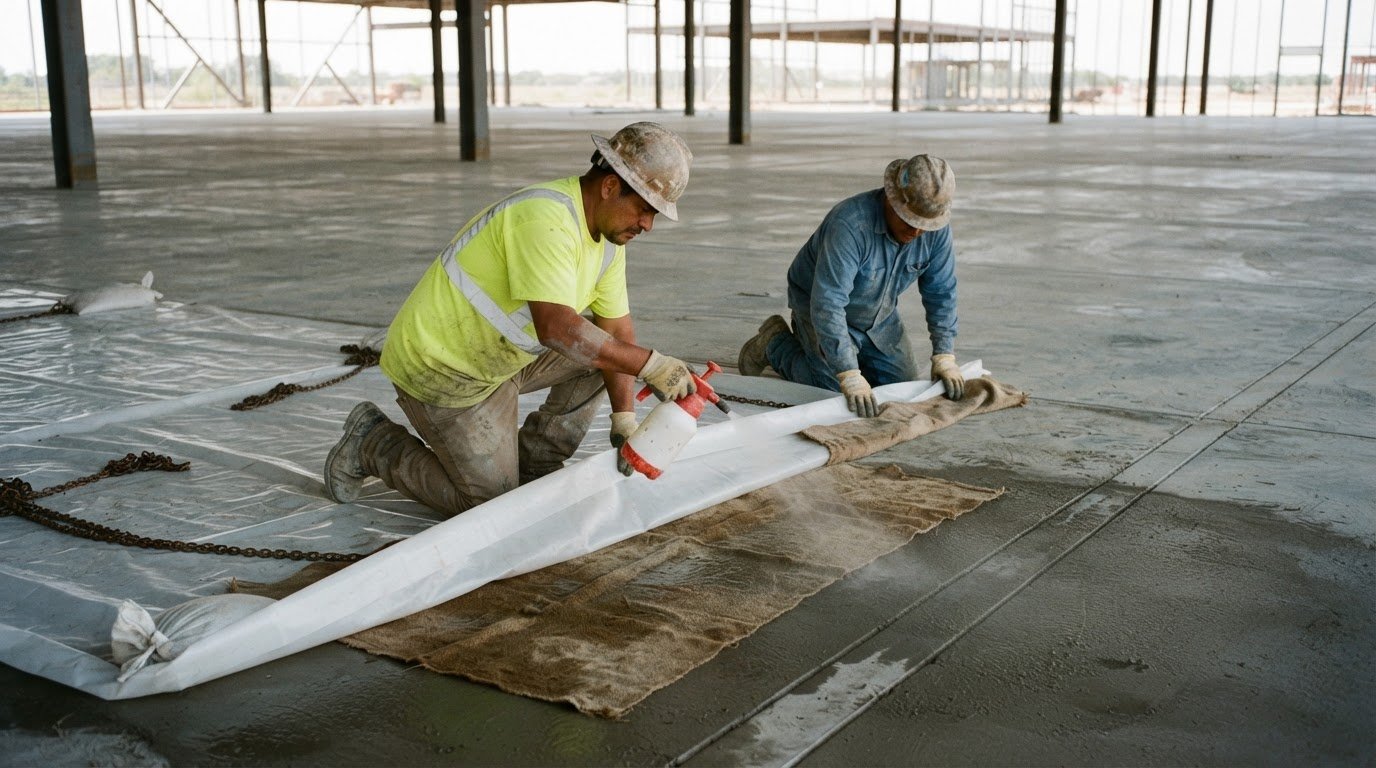
A concrete pour is only the start of the process that gives it strength. Cast-in-place concrete is poured and cured in its final location, so cast-in-place concrete quality control means managing conditions throughout the work. Weather, temperature, and humidity can affect curing time and final strength.
Concrete strength and durability depend on more than the mix alone. This guide explains how cast-in-place construction works and how consistent curing and correctly positioned reinforcement support performance. It also covers checks used to manage placement, curing conditions, and strength testing, helping you understand the process behind a dependable result.
Key Takeaways
- Understand how on-site placement and curing shape cast-in-place concrete, and why conditions during hardening matter.
- See how reinforcement placement and stable support help maintain structural quality.
- Learn how strength testing informs decisions about concrete readiness and durability.
- Recognize how ASTM and ACI guidance can inform quality-control procedures for placement and curing.
- Explore how Born Integrated Construction’s concrete and structural work can support projects that require cast-in-place construction.
Controlled curing and consistency
Before placement, professionals compare the mix design, delivery tickets, and batch-material records with project requirements. They coordinate placement and consolidation, manage interruptions that could create cold joints, and monitor curing conditions as the concrete hardens.
-
How Professionals Inspect Mix Design and Delivery Records
Before placement, compare the approved mix design with each delivery ticket and the related batch-material records. Confirm that the delivered mix meets project requirements, and document any discrepancy before placing the load. A clear record links each batch to its placement and supports consistent oversight throughout the pour.
Concrete must be placed within the specified timeframe, so professionals track delivery and placement timing. Visual appearance alone cannot establish whether a load matches the specified mix. Keeping delivery and material records together creates a traceable account of what was used.
-
How Professionals Monitor Curing Conditions
Track temperature, humidity, and weather during curing, as each can affect curing time and final strength. Low humidity can cause cement to lose too much water, while rain, snow, and temperature shifts can make consistent site conditions harder to maintain. Sensors and other monitoring tools can help document changes as the concrete hardens.
Maintain suitable curing conditions, including a temperature that supports hydration. One recommendation places concrete work between 68 and 72 degrees. For hot-weather and cold-weather concreting, refer to ACI 305 and ACI 306, respectively. Use the project’s specified curing method consistently, and record conditions so changes can be addressed during the work.
-
How Professionals Manage Placement and Curing
Plan placement so the crew can distribute and consolidate concrete steadily through the formwork. Vibrating concrete after placement helps identify holes and reduce the likelihood of honeycombing near slab sides. Coordinate delivery and placement to limit interruptions that could create a cold joint between adjoining sections.
After placement, maintain curing conditions as the concrete gains strength. Weather and humidity influence how quickly moisture leaves the concrete, so monitoring helps the team respond to changing site conditions. Consistent oversight connects placement, consolidation, and curing, reducing avoidable variation as the concrete hardens.
That work also calls for time on-site: cast-in-place concrete requires time on-site for formwork preparation, pouring, and curing. Treating those activities as connected parts of the work helps keep oversight in place from preparation through curing. Cast-in-place concrete requires on-site oversight and management to help ensure consistency, so responsibility for observing the work should continue as these activities proceed rather than stop once concrete has been poured.
Conditions remain a practical challenge. Cast-in-place concrete quality can be difficult to control, particularly during bad weather such as rain or snow. Low humidity can cause cement to lose too much water during cast-in-place construction. Cast-in-place concrete requires proper curing conditions, including maintaining the correct temperature for optimal hydration. Keeping attention on those conditions alongside the work’s progress gives the team a consistent basis for managing curing, especially when weather or humidity changes the conditions on-site.
Reinforcement placement
Set placement, reinforcement-cover, formwork, and finished-surface tolerances using the project drawings and specifications, since requirements depend on the structure. Controlled placement and consolidation help prevent voids and honeycombing. Assess any defects and choose repairs suited to their location and extent.
-
How Professionals Support Reinforcing Steel
Position and secure reinforcing steel according to the structural drawings before placement. Check that bars remain supported in their specified locations and do not shift as concrete moves through the formwork. This keeps the intended reinforcement arrangement within the finished element.
For walls, piers, columns, and similar vertical structures, reinforcing steel must be supported to prevent overturning and collapse under U.S. OSHA construction regulation 1926.703(d)(1). Inspect supports and connections before placement, and correct displacement or instability before concrete surrounds the steel.
Inspect reinforcement for visible damage or movement. Bent or displaced bars can change their position relative to the concrete surface and adjacent reinforcement, affecting the planned structural arrangement. Record any corrections as part of the placement inspection.
-
How Professionals Check Placement and Cover Tolerances
Compare reinforcement cover, formwork dimensions, placement, and finished-surface requirements with the project drawings and specifications. These documents set the tolerances for each element. A slab, wall, and column may have different requirements, so use the project criteria rather than a general numeric tolerance.
Before the pour, inspect formwork alignment and reinforcement position at representative locations. During placement, watch for movement that could change cover or finished dimensions. After placement, assess the surface against the specified finish requirements and record any deviation for review.
If an inspection identifies a defect, such as honeycombing near a slab side, document its location and extent. The project team can then determine a repair suited to the condition instead of applying a surface treatment without first assessing the defect.
-
How Professionals Respond to Damaged Shoring
Inspect erected shoring before and during concrete placement, and respond promptly if any component appears damaged or weakened. U.S. OSHA construction regulation 1926.703(b)(4) requires shoring weakened below the strength required by 1926.703(a)(1) to be reinforced immediately. Keep placement coordinated with these inspections so compromised support is addressed before work proceeds in that area.
If a shore shifts or shows damage during a pour, stop relying on that support and have the affected condition assessed. Document the location, corrective action, and inspection outcome. This connects shoring condition, concrete placement, and reinforcement checks in a consistent quality record.
Reinforcement helps concrete resist tensile forces and prevents the element from breaking. Its intended position matters as much as cover and surface checks. Confirm that the arrangement shown in the project documents remains in place, rather than simply noting that steel is present. If movement or damage is observed, record and correct it before concrete surrounds the steel, so placement does not conceal the condition.
After placement, compare the completed element with the applicable drawings and specifications, and document visible concerns for review. Linking placement checks to the reinforcement’s structural role helps the project team decide whether a deviation needs correction or a repair suited to the condition.
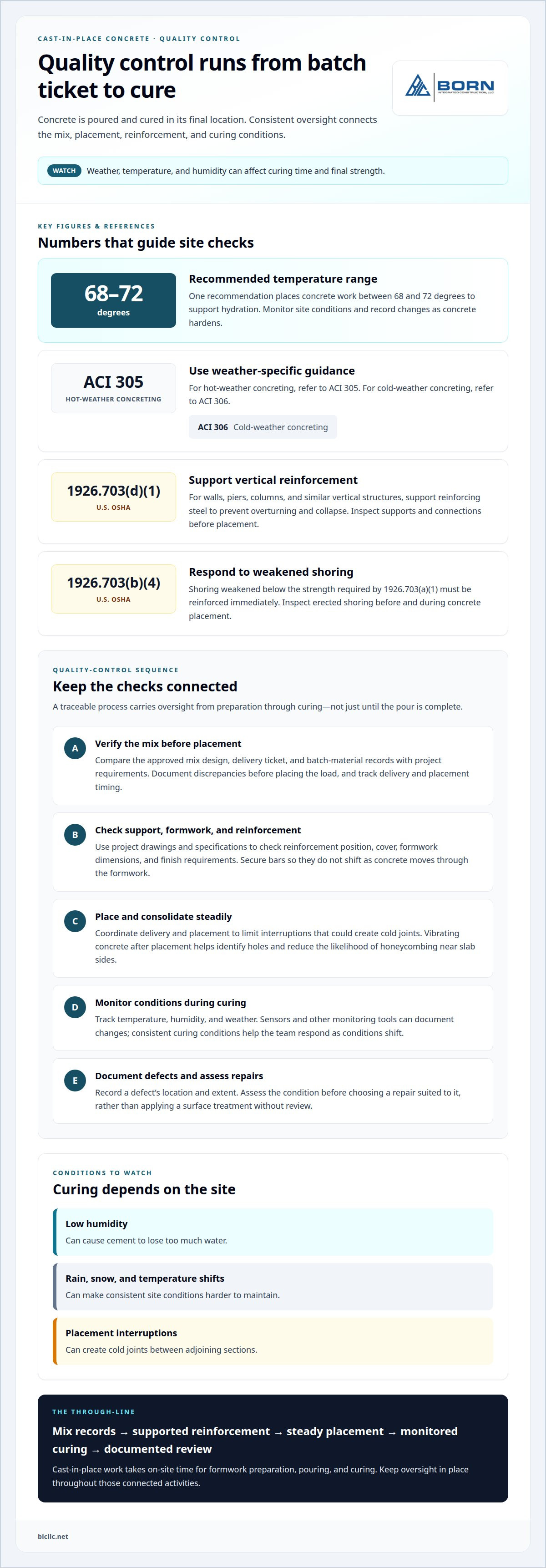
Strength and durability
Concrete strength testing compares measured performance with project requirements. Project documents assign responsibilities: contractors manage construction quality, owners set acceptance requirements, and independent testing agencies perform tests when engaged. Effective cast-in-place concrete quality control links each test result to the placement it represents.
-
How Professionals Conduct Concrete Strength Testing
Establish the sampling and testing process before placement, using the project specifications to define acceptance criteria. Take strength specimens from a composite sample collected from the middle of the load. A strength test requires at least two standard specimens cast from that sample, giving the team results to evaluate.
Use the testing age specified for acceptance or payment. Twenty-eight days is a typical age for concrete strength testing, but project requirements govern. Record the sample, placement location, test age, and results together so each value can be linked to the concrete it represents.
-
How Professionals Apply ASTM and ACI Standards
Apply the ASTM test method specified for the required strength assessment, and follow the project’s sampling and specimen procedures. Under U.S. OSHA construction regulation 1926.703(e)(1)(ii), strength testing used to support form and shore removal must use an appropriate ASTM standard test method designed to indicate compressive strength.
Keep acceptance testing distinct from removal decisions. Under U.S. OSHA construction regulation 1926.703(e)(1), forms and shores generally remain until the employer determines concrete can support its weight and superimposed loads, based on plans and specifications or suitable strength testing.
-
Use Test Results to Guide Structural Decisions
Compare each result with the specified strength, then document whether the concrete meets the project’s acceptance criteria. If results fall short, use the project’s investigation process to determine whether additional evaluation is needed. Concrete cores can help investigate failing strength results; the presentation advises taking a minimum of 3 cores for this purpose. Core results should be assessed against the specified compressive strength, not treated as a standalone judgment.
Keep structural loading and form removal tied to demonstrated capacity. Columns and other concrete elements may carry their own weight and later construction loads, so premature loading can affect the structure before it has adequate strength. Under U.S. OSHA construction regulation 1926.703(e)(2), reshoring must remain until supported concrete can carry its own weight and all loads placed on it. Document test results and removal decisions alongside the relevant plans and specifications as part of cast-in-place concrete quality control.
Cast-in-place concrete definition and characteristics
Cast-in-place concrete is poured at the job site and cured in its final location. Local building codes and project specifications set the applicable quality-control requirements, including approved materials, placement procedures, and acceptance criteria.
- Identify the governing requirements before planning the pour. The construction team uses the locally adopted building code and project specifications to establish the required mix, inspection records, placement conditions, and strength criteria. Requirements vary by jurisdiction and structure, so a foundation, basement wall, and structural slab may have different specifications.
- Confirm how the concrete will be formed and supplied. Wood or metal formwork holds fresh concrete in its intended shape while it cures and gains strength. Concrete may be mixed on-site or delivered ready-mixed; either method must follow the project’s specified mix design and placement plan.
- Understand how cement contributes to hardening. Water and cement react through hydration, binding the mix as it hardens. Curing conditions influence this process, while aggregates and approved proportions determine how the mix behaves during placement. Changing the specified mix can affect workability and the expected properties of the finished element.
- Cast-in-place construction is defined by where the concrete reaches its final form. Common examples include large foundations, structural slabs, and basement walls. Because concrete is formed and cured on-site, the project team coordinates formwork, reinforcement, access, placement, and curing at the location. This method can create continuous structural elements shaped to the project drawings.
- Consider the difference between cast-in-place and precast construction when assessing project needs. Precast concrete is produced off-site in a controlled environment and then transported for installation. Cast-in-place concrete is poured and cured at the construction site, making site conditions and sequencing integral to the work. The design, element size, access, and installation plan help determine which approach suits the structure.
- Use the specifications as the reference for every inspection and acceptance decision. Project documents define the required mix, formwork details, placement approach, and strength criteria. Records linking these requirements to the installed work help the team assess whether the finished concrete meets the intended design.
What are the ASTM and ACI standards for cast-in-place concrete quality control?
- Before construction, use the project specifications to identify applicable ASTM test methods and ACI guidance. The documents should state which properties require testing, how samples are handled, and which acceptance criteria apply. ASTM and ACI references provide defined procedures, while project documents connect those procedures to the concrete placement.
- Match each test to the decision it supports. For compressive-strength testing used to support form and shore removal, U.S. OSHA construction regulation 1926.703(e)(1)(ii) requires an appropriate ASTM standard test method designed to indicate compressive strength. Keep acceptance testing distinct from tests used to inform removal decisions.
- Establish specimen handling conditions in the quality-control plan. Standard-cured concrete specimens should be kept between 60°F and 80°F. Record their identification and curing conditions alongside the sample information, so the test result can be interpreted in context. Avoid treating field-cured specimens as standard-cured specimens.
- Apply ACI guidance to weather-related planning. ACI 305 addresses hot-weather concreting, while ACI 306 addresses cold-weather concreting. Use the relevant guidance when planning placement and curing under those conditions, and record observed site conditions. Temperature and humidity can affect curing time and the concrete’s final strength.
- Set sampling, testing, and reporting responsibilities before the pour. The plan should link the sample location, delivery, test method, and acceptance criteria. For example, take strength specimens from a composite sample collected from the middle of the load. Maintain records so each result can be traced to the concrete it represents.
- Compare results with the specified requirements and document the response to any deviation. ASTM test procedures provide a consistent way to measure the property under examination, while ACI guidance informs construction practices such as weather planning. Neither replaces project-specific acceptance criteria. Keep the governing specifications, test records, and decisions together in a traceable quality-control record.
Born Integrated Construction
For project teams planning cast-in-place concrete work, Born Integrated Construction provides concrete construction services with an emphasis on safety, integrity, efficiency, and quality. Its services support projects that need coordinated planning for concrete placement, structural elements, and site execution.
Consider involving Born Integrated Construction as the project scope takes shape, particularly when concrete work is a substantial part of a building or site plan. Early coordination helps align the intended structure, drawings, specifications, access, and construction sequence. Clear project information provides a basis for defining the required work and how it fits into the overall development.
Born Integrated Construction offers Concrete Paving, Slab on Grade, Podium Slabs, and CIP Garages. These are distinct concrete services suited to different project needs. A slab-on-grade element, for example, differs from a podium slab or a cast-in-place garage. The plans and the role of each element determine the appropriate scope.
Born Integrated Construction provides concrete construction for residential, commercial, and infrastructure development. Its services connect with the quality-control principles discussed above: defined project requirements, coordinated placement, suitable reinforcement support, and attention to curing and strength testing. These considerations guide the construction process, while project specifications establish acceptance criteria.
For an initial discussion, prepare the plans, specifications, project scope, and relevant schedule information. Include the concrete elements involved and any known requirements for placement, testing, or sequencing. This gives the team a clear starting point to discuss how the work can meet the project’s needs, while keeping project-specific design and specifications as the basis for quality control.
To discuss concrete work for your project, contact Born Integrated Construction.
Frequently Asked Questions
What Is Cast-in-Place Concrete?
Cast-in-place concrete is placed into forms at its permanent position in a structure, rather than manufactured as a separate unit for later installation. A basement wall is one example: it is formed on-site to suit the building plans. The construction sequence accounts for formwork, reinforcement, concrete delivery, placement, and curing at that location.
What are the key quality control steps for cast-in-place concrete construction?
Start with project specifications, then coordinate material records, site conditions, reinforcement, formwork, placement, curing, and strength testing. Keep inspection and test records linked to the relevant pour so the team can trace results to the concrete they represent. For Texas projects in Houston, Austin, San Antonio, Dallas, Fort Worth, San Marcos, New Braunfels, Boerne, Beaumont, Conroe, Woodlands, and Arlington, apply local requirements alongside the project documents.
What concrete tests are required for cast-in-place work, including slump, air content, temperature, and compressive strength?
The project specifications and approved testing plan determine which tests apply; slump, air content, concrete temperature, and compressive strength are not automatically required for every mix. Compressive-strength specimens should come from a composite sample taken from the middle of the load. A strength test uses at least two standard specimens, and 28 days is a typical testing age for acceptance or payment.
How often must cast-in-place concrete samples and cylinders be tested under ASTM and ACI standards?
Project specifications and the applicable testing plan set sampling frequency and cylinder test ages; there is no single schedule for every pour. The plan identifies which placements each sample represents and when specimens are tested. Separate pours or mix designs may require distinct sampling points so results remain attributable to the concrete being evaluated. Follow the specified ASTM method for the intended test.