
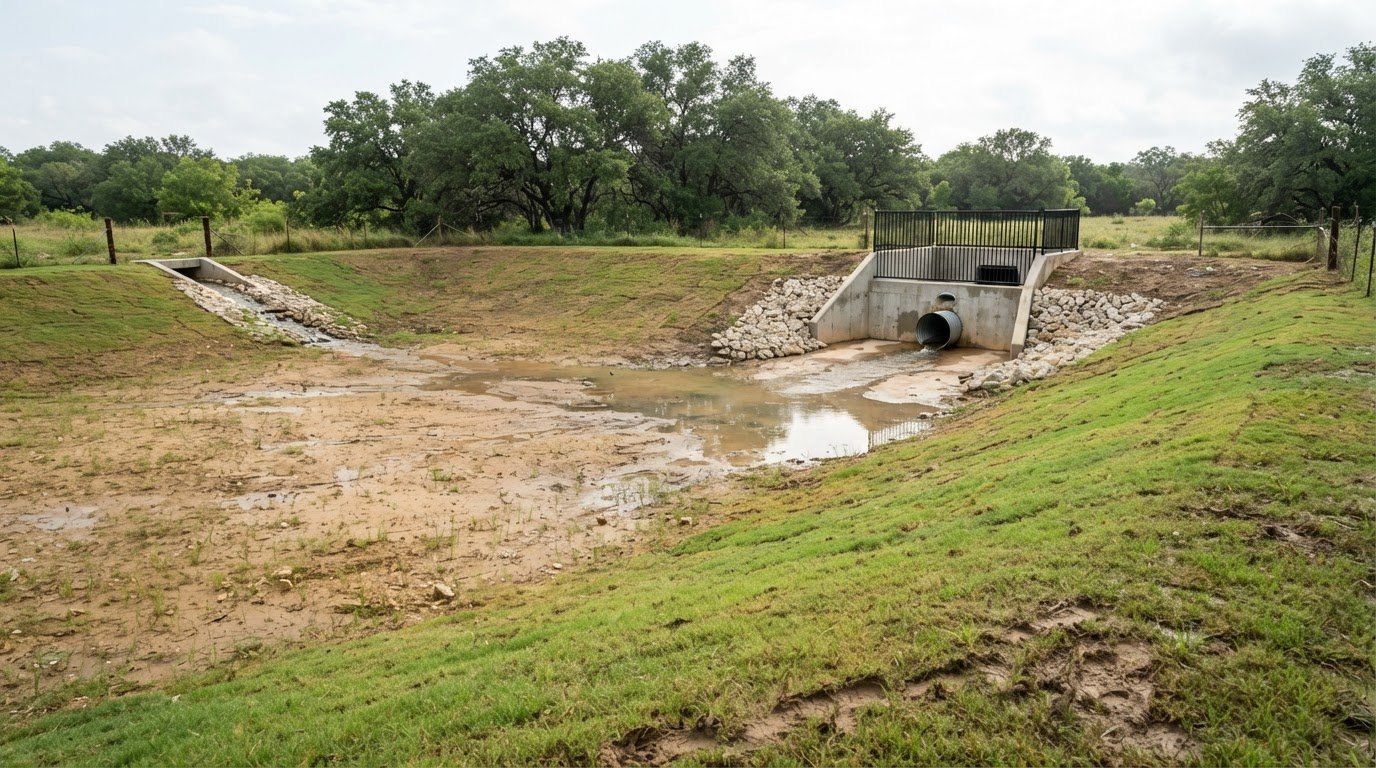
A detention pond is not automatically the right stormwater solution for every San Antonio project. Stormwater detention pond construction in San Antonio is generally considered when a site needs to store runoff temporarily and release it at a controlled rate. A retention pond, by contrast, is designed to hold water long term. The drainage plan and site conditions determine the appropriate approach.
It is reasonable to want clarity on compliance and construction costs before work begins. The budget depends on factors such as excavation, soil conditions, grading, drainage structures, and the required stormwater storage. There is no single standard design or scope for every site.
This article explains the difference between detention and retention ponds, what shapes the design decision, and which construction and post-construction stormwater requirements may apply in the San Antonio area. It also covers how site conditions and project plans affect construction scope, maintenance responsibilities, and cost, so you can understand the decisions involved before moving ahead.
Key Takeaways
- Plan for erosion controls during construction and ongoing vegetation care, since both affect how well a basin functions over time.
- A detention pond stores runoff temporarily and releases it through a controlled outlet; the drainage plan may also allow other storage methods.
- Stormwater approvals and post-construction obligations depend on the site’s location, including whether it is in an Edwards Aquifer protection zone or unincorporated Bexar County.
- Soil permeability, rainfall volume, downstream flood risk, project size, and local ordinances all inform pond design and construction scope.
- Construction costs are project-specific and depend on the approved plans, site conditions, excavation, and required drainage work.
Vegetation management and erosion prevention
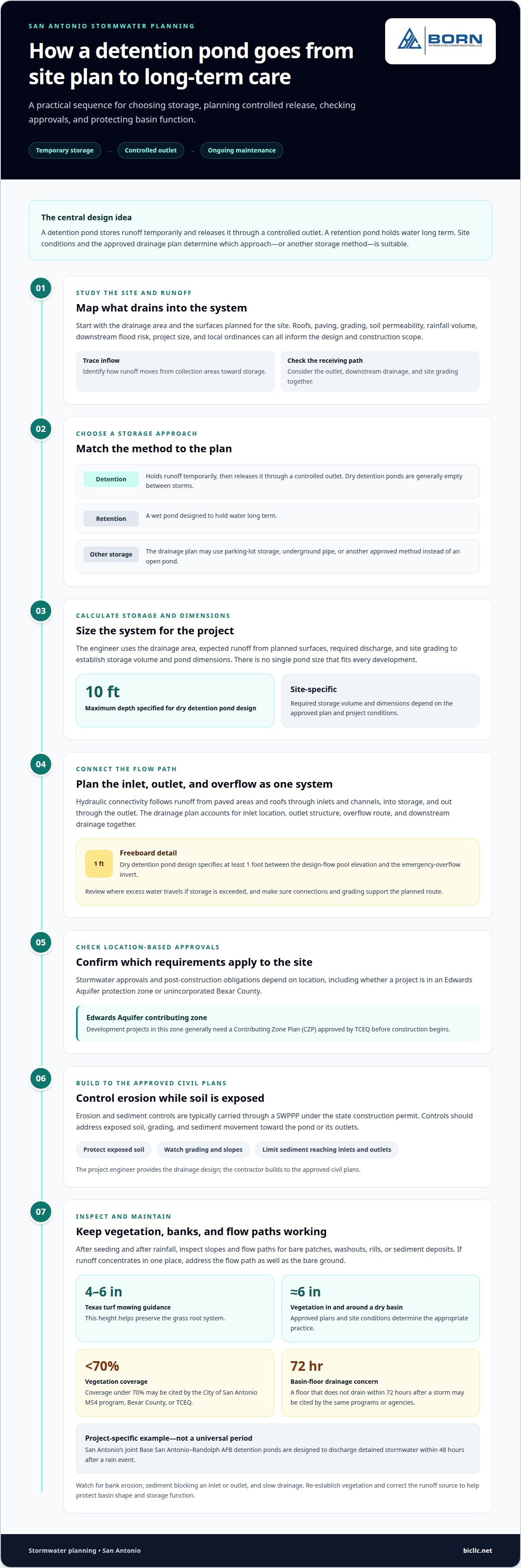
Vegetation helps protect a detention basin’s soil from erosion and stabilize its banks. For Texas turf, detention-basin grass is typically mowed to four to six inches to preserve the root system. Vegetation in and around a dry detention basin should be maintained at approximately six inches high. These figures describe related maintenance guidance; the approved plans and site conditions determine the appropriate practice.
During construction, erosion and sediment controls are typically carried through a SWPPP under the state construction permit. The controls should address exposed soil, grading, and sediment movement toward the pond or its outlets. After seeding, inspect slopes and flow paths for bare patches, washouts, or sediment deposits. A south slope with a 30 percent vegetation gap illustrates how uneven coverage can leave soil exposed to runoff.
Vegetation coverage under 70 percent may be cited by the City of San Antonio MS4 program, Bexar County, or TCEQ. A thin or failed grass cover can also leave banks more vulnerable to erosion. Re-establishing vegetation and correcting the source of runoff helps protect the basin’s shape and storage function. Landowners should account for erosion control and long-term maintenance responsibility when planning pond construction.
Bank erosion can carry soil into a basin, where sediment may affect the pond floor and obstruct connections to inlets and outlets. Inspect where incoming drainage meets the bank, looking for rills, exposed soil, or sediment blocking the flow path. If runoff concentrates in one location, address the flow path as part of the repair rather than treating bare ground alone. Seeded areas need suitable establishment conditions and follow-up inspection, particularly after rainfall disturbs the soil.
Dry detention ponds are generally empty between storms and temporarily hold runoff before releasing it at a controlled rate. Wet ponds, including retention ponds, hold water long term. Underground systems store runoff below ground rather than in an open basin. Each approach has different site and maintenance implications, so the drainage plan determines which system is suitable.
Common risks include bank erosion, sediment blocking an inlet or outlet, and a basin floor that drains too slowly. A floor that does not drain within 72 hours after a storm may be cited by the City of San Antonio MS4 program, Bexar County, or TCEQ. Open ponds also require attention to safe access and maintained banks. A practical way to identify the right project team is to establish who provides the drainage design and who constructs to the approved civil plans; the project engineer provides the design, and the contractor follows those plans.
Temporary stormwater storage and controlled release
Detention ponds temporarily hold runoff and release it through a controlled outlet. For a San Antonio site, the drainage plan determines the pond’s size and storage capacity, based on the area contributing runoff and the required release behavior.
Hydraulic Connectivity and Flow Controls
Hydraulic connectivity describes how runoff moves from paved areas and roofs through inlets, channels, and the pond to its outlet. Each connection affects how water enters storage and how steadily it leaves. The drainage plan must account for the inlet location, outlet structure, overflow route, and downstream drainage path as one connected system.
During review, look at how the outlet controls discharge and where excess water travels if storage is exceeded. Dry detention pond design specifies at least 1 foot of freeboard between the design flow pool elevation and the emergency overflow invert. This separation helps preserve an overflow path above the design flow level. The design also needs to fit site grading and downstream drainage.
Pond Sizing and Storage Capacity
Storage calculations start with the site’s drainage area and the runoff expected from its planned surfaces. The engineer uses those inputs, the required discharge, and the site grading to establish the necessary storage volume and pond dimensions. A drainage plan may provide storage through an open pond, parking-lot storage, underground pipe, or another approved method.
There is no single pond size that fits every development. The chosen method must work with the project layout, connected drainage features, and outlet controls. Dry detention pond design specifies a maximum depth of 10 feet, while the required storage volume remains specific to the site and plan.
In the Edwards Aquifer contributing zone, the contributing land is upstream and drains toward the recharge zone. Development projects in that zone generally need a Contributing Zone Plan, or CZP, approved by TCEQ before construction begins. This site-specific approval should be considered alongside pond sizing and drainage connections.
For example, a development that directs runoff from roofs and paving into one basin needs a continuous route from collection points to the inlet, through storage, and out through the control structure. If a connection is undersized, blocked, or graded incorrectly, the planned storage and release may not function as intended. The engineer’s drainage design establishes these relationships, and construction follows the approved civil plans.
San Antonio’s Joint Base San Antonio-Randolph AFB stormwater detention ponds are designed to discharge detained stormwater within 48 hours after a rain event. That project-specific period illustrates how a design can define a release objective; it should not be assumed to apply to every site. The controlling plan sets the storage and discharge requirements for each project.
Construction and post-construction stormwater requirements
Stormwater compliance covers approvals during construction and obligations after a site is stabilized. For stormwater detention pond construction in San Antonio, the required steps depend on the project location and applicable permits.
Permits and Construction Approvals
TCEQ’s TXR150000 construction general permit applies while a site is under construction. The transition from construction to ongoing stormwater management depends on site conditions and applicable permit requirements. This construction permit is separate from post-construction stormwater obligations, so the transition between construction and operation needs to be planned.
Location matters. Development projects in the Edwards Aquifer recharge zone generally need a Water Pollution Abatement Plan, or WPAP, approved by TCEQ before construction begins. Bexar County requires a permit for projects where a WPAP or Contributing Zone Plan applies. SAWS reviews and comments on aquifer protection plans through its aquifer protection program.
For projects in unincorporated Bexar County, post-construction stormwater permits require quarterly maintenance reports, annual permit renewal, and a certified maintenance provider. Assigning responsibility and establishing the reporting process are part of project planning, not just final construction details. Identifying the applicable jurisdiction and approvals helps set the construction sequence for stormwater detention pond construction in San Antonio.
Pond Design and Construction Steps
The process begins with a site assessment and drainage design. The engineer establishes the pond location, storage approach, inlet and outlet arrangement, and grading in the civil plans. The plans also define construction needs, including excavation and connections to the site drainage system. Every element must work as part of a complete runoff route.
Construction follows the approved civil plans, progressing through site preparation, excavation, grading, and installation of the planned drainage features. Erosion and sediment controls remain important while the site is disturbed. The construction sequence should protect completed work from runoff and keep sediment out of inlets and the basin.
After construction, a final review checks compliance and functionality. It should confirm that the pond and drainage features match the approved plans and operate as intended. Before long-term operation begins, establish who will manage maintenance records, required reports, and permit renewal. In unincorporated Bexar County, quarterly reports and annual renewal make clear documentation especially important.
Permit coordination can affect the order of work. For example, a project requiring a TCEQ-approved WPAP must account for that approval before construction begins. A site under TXR150000 also needs a defined path from active construction to stabilization and an accepted Notice of Termination. Keeping approvals, civil plans, construction records, and post-construction responsibilities aligned supports a more orderly handoff from building to operation.
Factors engineers and counties consider
San Antonio pond design depends on how the site receives, absorbs, and directs runoff. Engineers assess soil permeability, rainfall volume, downstream flood risk, project size, and local ordinances. These factors influence whether a pond is needed, where it can fit, and how it connects to surrounding drainage.
Soil permeability affects how readily water moves through the ground. A site assessment considers this alongside grading and drainage paths to identify a suitable pond location. For example, soil that absorbs water slowly can affect how runoff travels across a development. The engineer accounts for that movement in the drainage design.
Rainfall volume and downstream flood risk also shape the design. The drainage plan must address runoff from the proposed site and its potential effects beyond the property. A large paved area, such as a commercial development, can change how runoff reaches nearby drainage routes. Required pond capacity and outlet arrangement therefore depend on the site’s runoff contribution and downstream conditions.
Project size and location matter, but a pond is not automatically required on every property. Properties with small pads or at high elevations near a river typically do not require a pond. Local ordinances and the project’s drainage characteristics also inform the decision. A site assessment helps determine whether an open basin suits the layout or another approved storage method is a better fit.
Floodplain review is a separate design consideration. Floodplain fill mitigation replaces flood storage lost when fill is placed in a floodplain, and many jurisdictions require it separately from detention. A detention pond manages runoff from development; it does not automatically replace lost floodplain storage. Engineers must account for both needs when a project includes fill within a floodplain.
Local requirements can vary by county and jurisdiction. Texas counties often require engineered approval before detention or retention pond construction begins. In the Edwards Aquifer recharge zone, surface water enters the aquifer directly, and the zone has the strictest controls. The contributing zone is upstream land that drains toward the recharge zone, so a site’s location in either area can affect project review.
For dry detention basins, the minimum flow length-to-width ratio is 1. That criterion informs basin geometry, while grading and available land shape its placement. A constrained parcel may require careful coordination between pond dimensions, building areas, and drainage connections. The engineer’s design must reconcile those site limits with storage and local criteria.
Engineers consider these factors together rather than relying on one measurement. They assess soil permeability, rainfall volume, downstream flood risk, and applicable county rules. This coordinated review determines whether detention is appropriate and how the design can respond to the property’s drainage conditions.
What permits and approvals are needed to construct a detention pond in San Antonio?
Approvals depend on the site’s location and applicable stormwater programs. In San Antonio, Edwards Aquifer zones, Bexar County requirements, construction permits, and floodplain conditions can all affect the approval process.
For a project in the Edwards Aquifer recharge zone, a Water Pollution Abatement Plan (WPAP) generally needs TCEQ approval before construction begins. The Edwards Aquifer Protection Program governs regulated activity over the aquifer. SAWS reviews and comments on aquifer protection plans through its aquifer protection program. These reviews address site activities that could affect the aquifer, making the project’s location and proposed work important.
Projects in the Edwards Aquifer contributing zone generally need a Contributing Zone Plan (CZP) approved by TCEQ before construction begins. The contributing zone is upstream land that drains toward the recharge zone. Bexar County requires a permit when a WPAP or CZP applies. Identifying the aquifer zone early helps establish which plan and county permit are needed before construction scheduling proceeds.
Some projects also require environmental permit coordination. The Joint Base San Antonio-Randolph AFB pond project includes coordination for permits under the Clean Water Act Section 404 Nationwide Permit. It also includes coordination with the U.S. Army Corps of Engineers and TCEQ for required stormwater permits. That project includes National Environmental Policy Act compliance and coordination with environmental agencies. These are project-specific requirements, not a universal checklist for every San Antonio pond.
Construction stormwater coverage is a separate consideration. TCEQ’s TXR150000 construction general permit applies only while a site is under construction. It ceases to apply once the site is stabilized and its Notice of Termination is accepted. This makes stabilization and permit closeout part of the construction sequence. The approved civil plans and construction schedule should account for these steps.
Floodplain work may trigger a separate review. Floodplain fill mitigation replaces flood storage lost when fill is placed in a floodplain, and many jurisdictions require it separately from detention. A pond designed to control runoff does not automatically replace this mitigation. The site plan should distinguish detention from any floodplain storage displaced by fill.
A practical approval sequence is to identify the site’s jurisdiction and aquifer zone, determine whether a WPAP or CZP applies, and coordinate relevant permits before construction. The design and construction work then follow approved civil plans, with construction stormwater coverage maintained through stabilization and closeout. Discuss your detention pond project as you plan the work and its approvals.
Born Integrated Construction: Detention Ponds
Born Integrated Construction provides detention pond construction for development projects that require planned stormwater storage. The work is suited to projects where the approved drainage design calls for a pond and construction must align with site grading, drainage connections, and surrounding concrete work.
Bring the approved civil plans and project scope into the construction discussion. This helps define how the pond relates to nearby paving, a slab on grade, or podium slabs when those elements are part of the development. Clear coordination supports an orderly transition from design requirements to site work.
If your project has an approved pond design and a defined construction scope, contact Born Integrated Construction to discuss the work.
Set the Next Project Decision in Motion
For stormwater detention pond construction in San Antonio, the next step is to align the construction scope with the approved civil plans and the wider site layout. Early coordination can clarify how pond work relates to grading and adjacent concrete elements, helping keep responsibilities and sequencing clear.
This coordination is especially useful when a development includes several connected scopes. Born Integrated Construction offers Detention Ponds, Concrete Paving, Slab on Grade, and Podium Slabs. Discussing these elements together can help establish how they fit within the project’s planned work.
As your plans take shape, identify the pond scope and related site work you want to discuss. Contact Born Integrated Construction to discuss your project and its construction needs. A clear starting point can help move the work forward with confidence.
Frequently Asked Questions
Do I need a Detention or Retention Pond?
The choice depends on whether the project needs temporary runoff storage or long-term water retention. Commercial developments, subdivisions, and roadway projects commonly use detention ponds; larger developments and master-planned communities may use retention ponds. Consider the site’s intended function, available space, drainage plan, and ongoing maintenance responsibilities. A retention pond keeps water between storms, so its design and care differ from those of a basin that is usually dry.
Do All Projects Require a Pond?
No, a pond is not required for every project. The drainage plan may provide storage through an open pond, parking-lot storage, underground pipe, or another approved method. Properties with small pads or at high elevations near a river typically do not require a pond. Project size, runoff, downstream conditions, and local ordinances shape the decision, so pond construction should follow the site’s engineered drainage approach.
What is a stormwater detention pond and how does it work?
A stormwater detention pond temporarily holds runoff and releases it through a controlled outlet after rainfall. For example, runoff from a development’s paved areas can enter the basin, remain stored during the storm, and drain through the outlet afterward. The drainage design sets the pond’s storage and release arrangement. An open pond is one option; a plan may instead use parking-lot storage or underground pipe.
What are the City of San Antonio requirements for stormwater detention ponds?
Requirements depend on the site’s location, permits, and approved drainage plans. The City of San Antonio MS4 program, Bexar County, or TCEQ may cite a basin with vegetation coverage below 70 percent or a floor that does not drain within 72 hours after a storm. Projects in Edwards Aquifer protection zones may also need a TCEQ-approved plan before construction. Confirm the applicable approvals through the project’s permitting process.
What are the maintenance requirements and long-term costs for detention ponds?
Maintenance commonly includes vegetation care, inlet and outlet inspections, and sediment checks. A routine schedule calls for checking sediment depth annually, with more frequent checks after a 25-year storm. The original operation and maintenance manual may identify 18 to 24 inches of basin-floor sediment as a trigger for action. Long-term costs depend on the approved maintenance plan and the work required to keep the basin functioning.
How can I find qualified stormwater pond contractors and engineers in San Antonio?
Identify who will provide the drainage design and who will construct the pond according to the approved civil plans. The project engineer provides the design, and the contractor builds to those plans.