

Involve a turnkey contractor during pre-development or planning, before key site decisions are settled. A turn key site solutions provider in Houston can help coordinate budgeting, scheduling, value engineering, and constructability reviews while the project is still taking shape. Early coordination gives the team a clearer basis for planning the work.
It makes sense to align the site scope, schedule, and construction approach from the outset. Bringing a contractor in early helps address these considerations together, rather than treating site work as a late-stage task.
This article explains when to involve a turnkey contractor and what that involvement can contribute to a commercial design-build project. It also outlines the kinds of site and concrete construction services available across Greater Houston, so you can understand how the work may fit your project and where to begin.
Key Takeaways
- Bring a turnkey contractor into pre-development or planning so budgeting, scheduling, value engineering, and constructability can inform early decisions.
- Assess whether the project’s site and concrete scope aligns with services available across Greater Houston.
- Understand how project scope, site conditions, and sequencing shape the construction process and schedule.
- Evaluate a contractor’s approach to coordination, execution, and quality before work begins.
- Identify how scope assumptions and site conditions can affect project risks and costs.
Service areas
Commercial design-build services are available across Greater Houston. That regional scope matters because a project’s location shapes access, coordination, and construction planning. A site in Houston’s urban core may present different delivery and staging conditions from a site farther out. The work starts with understanding the actual property.
Greater Houston is a broad market, and a city name alone does not describe every site condition. A Houston project may involve constrained access, nearby operating businesses, or multiple parties sharing the property. Each condition affects how teams organize the work. The site address and project boundaries provide a practical starting point.
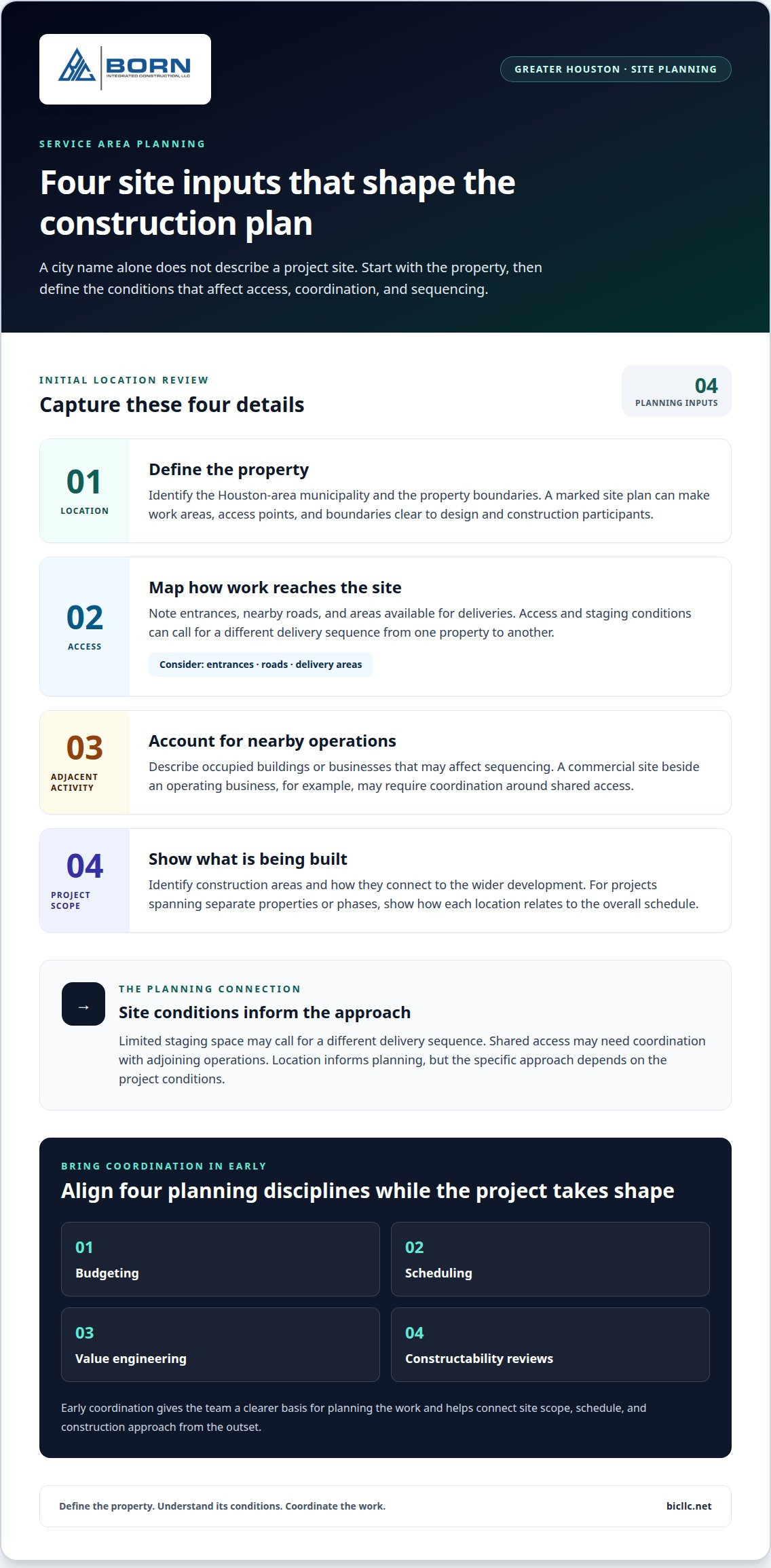
For an initial location review, project teams can organize information around:
- Site location: Identify the Houston-area municipality and the property boundaries.
- Access: Note the entrances, nearby roads, and areas available for deliveries.
- Adjacent activity: Describe occupied buildings or businesses that may affect sequencing.
- Project scope: Identify the construction areas and how they connect to the wider development.
These details define the work more accurately than a general reference to Houston. For example, a commercial site beside an operating business requires coordination around shared access. A site with limited staging space may need a different delivery sequence. Location informs planning, but the specific approach depends on project conditions.
Greater Houston projects may span separate properties or development phases. The team needs a clear view of each location and how it relates to the overall schedule. A marked site plan can show work areas, access points, and boundaries, supporting consistent communication among design and construction participants.
Service-area planning also involves practical coordination. Identify the site, consider how materials and crews will reach the work area, and establish which parties manage adjoining operations. Houston traffic and site access matter, but no single route or schedule suits every property.
Regional coverage must translate into site-specific execution. A commercial property in central Houston and a development elsewhere in Greater Houston may share broad goals but require different sequencing. Clear drawings, scope boundaries, and access information help align the construction plan with the actual location.
Start by defining the property and the work planned there. Then organize information about access, staging, adjacent activity, and project phases. These steps create a useful basis for discussing a Houston-area project and how its location affects design-build coordination.
Which turnkey site solutions providers serve Houston, Texas?
Houston, Texas, projects may involve different types of contractors, depending on the scope. A turnkey provider generally coordinates multiple construction activities under an integrated project approach. A specialty contractor focuses on a defined trade or structure. The distinction matters when a development needs both site preparation and structural work.
First identify the work the project requires. A commercial building with a parking structure, for example, needs different expertise from a site focused on access and paving. The provider’s role should match the scope, including how its work connects with design, scheduling, and other contractors.
Compare Houston-area provider capabilities by specific scope categories:
- Site coordination: Establish which site activities the contractor manages and how those activities connect to the building plan.
- Structural scope: Determine whether the project includes foundations, elevated structures, or parking facilities.
- Commercial use: Match experience to the intended property, such as a hotel, office, or mixed-use development.
- Project interface: Clarify how the provider coordinates with the design team and other construction trades.
These categories distinguish broad coordination from a narrowly defined service. For instance, an elevated parking structure requires coordination between structural design and construction sequencing. A development with extensive paved access places greater emphasis on site circulation and the connections between paved areas and building entrances.
Provider fit also depends on project geography within Greater Houston. A Houston site may have different access constraints from one in a surrounding community. In either case, the proposed work plan should address the property itself, not rely only on a general claim about serving the region. Location, site boundaries, and project drawings help define the scope.
Reviewing completed work can make a provider’s capabilities easier to understand. Look for examples that resemble the project’s building type, structural scope, or site arrangement. A hotel structure, for example, offers a more relevant comparison for hospitality development than an unrelated project. The commercial construction project examples illustrate how completed work can provide context for evaluating scope.
For a suitable match, connect the required work to the provider’s capabilities and coordination responsibilities. Assess a Houston provider by the work it will perform, how that work interfaces with the design, and whether relevant project examples align with the intended development. This makes a shortlist more useful than geography alone.
Connect the required work to an early scope review and a clearly defined provider role. Born Integrated Construction offers Turn Key Civil for projects requiring coordinated site construction. Involving the team during pre-development or planning allows the project team to consider budgeting, scheduling, value engineering, and constructability as the project takes shape. Use these discussions to clarify responsibilities, evaluate the anticipated scope, and identify open questions. The goal is to align the work with project requirements and establish a shared understanding of what needs coordination.
What is the process and timeline for a turnkey site project in Houston?
Involve a turnkey contractor during pre-development or planning. Early participation supports budgeting, scheduling, value engineering, and constructability reviews. These discussions help the team evaluate the site approach before design decisions become difficult to revise. The schedule then develops from the defined scope, site conditions, design coordination, and construction sequence.
A Houston commercial project typically moves through connected planning and execution stages. The order matters because decisions about access, structural work, and site preparation can affect later activities. A contractor can help organize those interfaces while the design team develops project documents.
- Define the project: Establish the property boundaries, intended building use, and construction scope. For example, a commercial development with a parking structure needs coordination between site access and structural work.
- Review constructability: Examine the design for practical sequencing, access, and work-area constraints. A restricted staging area may require deliveries to be coordinated with active construction.
- Develop the schedule: Connect design milestones, procurement needs, site preparation, and construction activities. The team identifies dependencies, such as completing an area before another trade can use it.
- Coordinate execution: Track progress against the agreed sequence and address changes that affect scope or interfaces. Clear communication helps keep design decisions connected to field conditions.
The schedule is project-specific, not a fixed duration for every Houston site. A defined scope and coordinated design give the team a stronger basis for sequencing. Unresolved design details, changing requirements, restricted access, or dependencies between trades can alter the planned order of work.
For example, a site with limited access may need a different delivery sequence from one with open staging areas. A project combining a building structure and parking facilities also needs careful coordination between those work packages. The schedule should show how activities relate, rather than present isolated dates.
During planning, identify decisions that may affect progress. These include the boundaries of each contractor’s work, how design revisions are handled, and what must be complete before another activity begins. Recording these interfaces makes schedule discussions more specific and helps prevent gaps between project participants.
As construction proceeds, progress reviews compare completed work with upcoming activities. If a field condition differs from the design assumptions, the team can assess the effect on sequencing and communicate the required response. This disciplined process keeps the timeline connected to actual site conditions and supports coordinated delivery.
How can I evaluate and verify a Houston site solutions contractor?
Evaluate a Houston contractor by how clearly it defines responsibilities, communicates decisions, and documents work. For a commercial development, the proposed scope should identify included activities, project interfaces, and assumptions. Clear boundaries help the owner understand who handles each portion and where coordination is required.
A turn key site solutions provider in Houston should connect its proposed work to the project’s actual requirements. A development with structural work and site improvements, for example, needs coordination across those scopes. Review how the contractor explains sequencing, design coordination, and communication when conditions change. Specific explanations are more useful than broad claims.
Use a consistent review framework for each proposal:
- Scope clarity: Check whether the proposal distinguishes included work, exclusions, assumptions, and interfaces with other trades.
- Project relevance: Compare the contractor’s experience with the building type and construction demands of the planned development.
- Planning approach: Review how scheduling, constructability, and design coordination are addressed.
- Communication structure: Identify who manages decisions, shares updates, and records changes during construction.
Documentation is central to verification. A written scope provides a reference for comparing proposed work with design documents. A schedule shows how activities depend on one another, while change records explain how revisions affect responsibilities and sequencing. Together, these materials provide a traceable basis for project discussions.
Project examples can support an evaluation when they are relevant to the proposed scope. A commercial parking structure, for instance, offers useful context for a project with similar structural demands. Compare scope and coordination, not appearance alone. Similar-looking projects may involve different responsibilities or construction conditions.
During planning, the contractor can make its process visible through defined review steps. These may include checking design assumptions, identifying work interfaces, and documenting decisions that affect construction. If the site plan changes, the team records the affected scope and communicates the implications to project participants. This gives the owner a clearer view of how decisions move into execution.
Evaluation also depends on the owner’s priorities. A project with a demanding schedule may place greater weight on sequencing and decision flow. A complex building program may require closer attention to structural coordination. Criteria should reflect the actual project, rather than a generic checklist for every Houston development.
Before selection, consolidate the scope, schedule expectations, and coordination needs into a shared review basis. This makes proposals easier to compare and supports a precise discussion of responsibilities. A sound evaluation rests on documented scope, relevant experience, and a practical plan for managing the work.
What risks and hidden costs should I consider when hiring a turnkey site provider
Unclear scope creates financial exposure on a Houston commercial project. If a proposal assumes another party will handle a site interface, that work may require separate coordination later. For example, unclear responsibility for transitions between paving and building access can lead to added work or delays. Written boundaries help identify gaps before construction begins.
Site conditions can differ from planning assumptions. Existing improvements, concealed obstructions, or unexpected ground conditions may affect the construction method. Identify what information supports the proposal and how new findings will be reviewed. A documented process helps distinguish changed conditions from work already included in the scope.
Review the proposal for cost exposure in several areas:
- Scope exclusions: Look for omitted work, interfaces, and responsibilities assigned to others.
- Design changes: Understand how revisions are assessed, documented, and incorporated.
- Site assumptions: Identify the conditions the schedule and work plan rely on.
- Schedule dependencies: Note activities that could affect crews, deliveries, or follow-on trades.
- Coordination gaps: Clarify how decisions affecting multiple parties are recorded and communicated.
Change management is especially important when design information develops during construction. A revised entrance location, for instance, can affect adjacent site work and the sequence of follow-on activities. If the change process is vague, the team may lose time resolving responsibility and impacts. Defined review and documentation procedures reduce ambiguity.
Schedule disruption can create indirect costs even when the scope stays the same. If one activity cannot proceed, dependent crews or deliveries may need to be reorganized. A practical schedule identifies dependencies and assigns responsibility for communicating changes. This is useful on commercial sites where several work areas operate at once.
Quality risks can become costly when project requirements are interpreted differently. The proposal, drawings, and written clarifications should describe the same intended work. For example, a difference between a specified site boundary and the boundary assumed in a proposal can create disputes during execution. Resolve discrepancies early, before work begins.
Before work starts, document assumptions, exclusions, decision paths, and change procedures in project records. The owner and design team then have a shared reference when conditions or requirements shift. For a Houston project combining site and building work, this discipline helps expose cost risks without relying on unsupported price estimates.
Discuss your project scope to clarify responsibilities, assumptions, and coordination needs before construction proceeds.
Demand response or load management can reduce costs and carbon footprint by avoiding high load demand on a building’s electrical system.
Born Integrated Construction: Turn Key Civil
Born Integrated Construction provides Turn Key Civil for commercial projects that need coordinated site construction. Involve the team during planning when civil work needs to align with building construction or when concrete scope must fit the site sequence.
Relevant services include Concrete Paving, Slab on Grade, and Podium Slabs. A commercial development may need paving to connect access areas with the building, or a podium slab as part of its structural plan. Clear scope and early coordination help integrate these elements into the wider project schedule.
Share the project location, drawings, intended use, and known site requirements to start a focused discussion. Contact Born Integrated Construction to discuss your commercial project.
Move Your Commercial Project Forward
A commercial project’s next step is to turn its design intent into a clearly defined construction scope. Aligning site work with the building plan establishes a practical basis for coordination. A turn key site solutions provider in Houston can support that transition when civil and concrete work are part of the project requirements.
Born Integrated Construction provides Turn Key Civil, with related services including Concrete Paving, Slab on Grade, and Podium Slabs. These services can support projects where paving, building slabs, or podium construction must connect with the broader development plan.
As you prepare to advance the project, gather the current drawings, site information, and a clear description of the work under consideration. Those details provide a useful starting point for discussing scope and coordination. Contact Born Integrated Construction to discuss your commercial project and its construction requirements. A clear next step can help bring the project team into alignment.
Frequently Asked Questions
How early should a turnkey contractor be involved in my project?
Bring the contractor in during pre-development, before the design and site scope are fixed. This gives the team an opportunity to consider construction sequencing while the owner and design professionals can still shape decisions. Prepare a current site plan, intended building use, known access constraints, and work already assigned to others. For a Houston commercial project, these details help define where civil coordination should begin and which interfaces need attention.
What does “turnkey construction” mean?
Turnkey construction is a delivery arrangement in which a contractor manages an agreed project scope through construction, coordinating the work needed to hand over a completed facility for its intended use. The contract defines the responsibilities, so the term alone does not establish which trades are included. One agreement may cover site and structural work, while another defines a narrower package within a larger commercial build.
What is a turnkey site solutions provider?
A turnkey site solutions provider coordinates multiple site-related construction responsibilities under one defined scope. Rather than performing only one trade, the provider organizes how included activities connect with design documents, building work, and project sequencing. A commercial development may need earthwork, detention features, paving, and structural interfaces coordinated. The project agreement, not the label alone, defines the provider’s role.
What services do Houston turnkey site providers offer?
Turnkey site providers in Houston may handle civil work and concrete construction, but scope varies by company and project. Born Integrated Construction provides Turn Key Civil, Mass Soil Excavation, Detention Ponds, Paving Stabilization, Retaining Walls, Concrete Paving, Slab on Grade, and Podium Slabs. Its Texas service locations include Houston, Austin, San Antonio, Dallas, Fort Worth, San Marcos, New Braunfels, Boerne, Beaumont, Conroe, the Woodlands, and Arlington. Match the service scope to the site requirements.